Rose · Note 01
The ground it
grows on
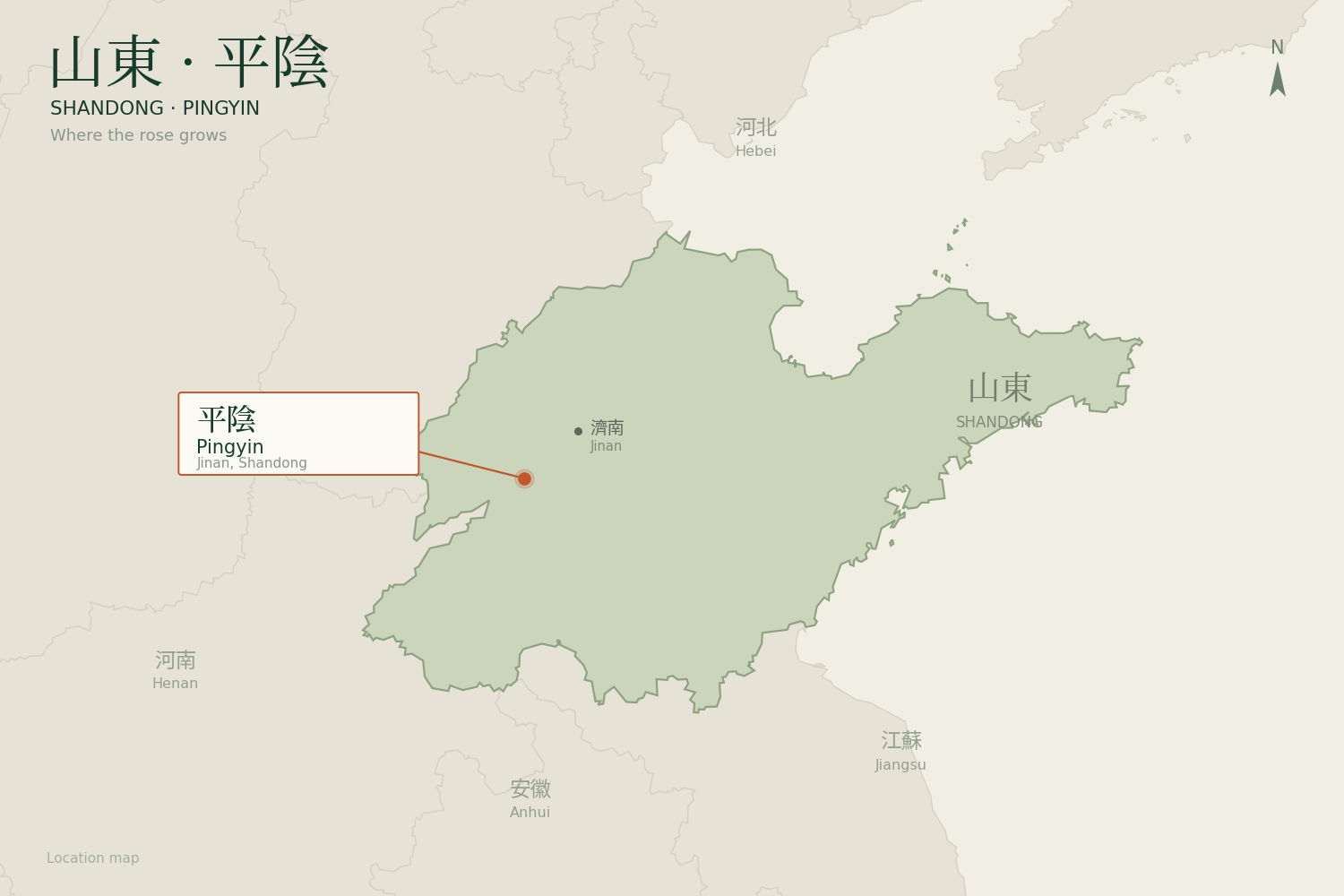
Pingyin sits on the western edge of the province, where the Tai mountains run out into the plain.
Province
Shandong
County
Pingyin, Jinan
Coordinates
36.02–36.38° N, 116.20–116.45° E
Elevation
100–250 m
Soil
Cinnamon soil
Soil pH
7.0–8.5
Organic matter
1.2% and above
Cultivars
Pingyin No. 1 and No. 2
Flowering
Mid-April to late May
The hills
Pingyin sits where the Tai mountains run out westward and break up into low hills before the plain begins. Nearly two thirds of the county is hill country, most of it between 100 and 250 metres, and the rose is planted on the slopes and terraces rather than the flat ground below — which is kept for grain.
The county's latitude, 36 degrees north, puts it inside the band between 30 and 45 degrees where most of the world's scented roses are grown — the same belt that runs through Turkey, Bulgaria and Morocco.
The soil
Cinnamon soil at pH 7 to 8.5 — neutral to distinctly alkaline, which is unusual. Most flowering shrubs are grown on slightly acid ground, and a rose gardener in Europe would read those numbers as a problem to correct.
Here it is not corrected, because it is part of what the place is. The soil runs deep, over a metre in most plots, with organic matter at 1.2 percent and above, and the groundwater carries a light mineral load of its own.
The season
Buds appear in the middle of April, the first flowers open at the end of that month, the peak falls in mid-May, and it is over by the end of the month. Six weeks, once a year.
That compression is the reason the local meteorological office runs phenology stations through the flowering period and issues harvest bulletins every few days. A misjudged week is not a smaller crop — it is most of the crop.
This page describes a plant and its place in Chinese herbal tradition. It is not a description of what our products do, and nothing here is medical advice.