Lavender · Note 01
The ground it
grows on
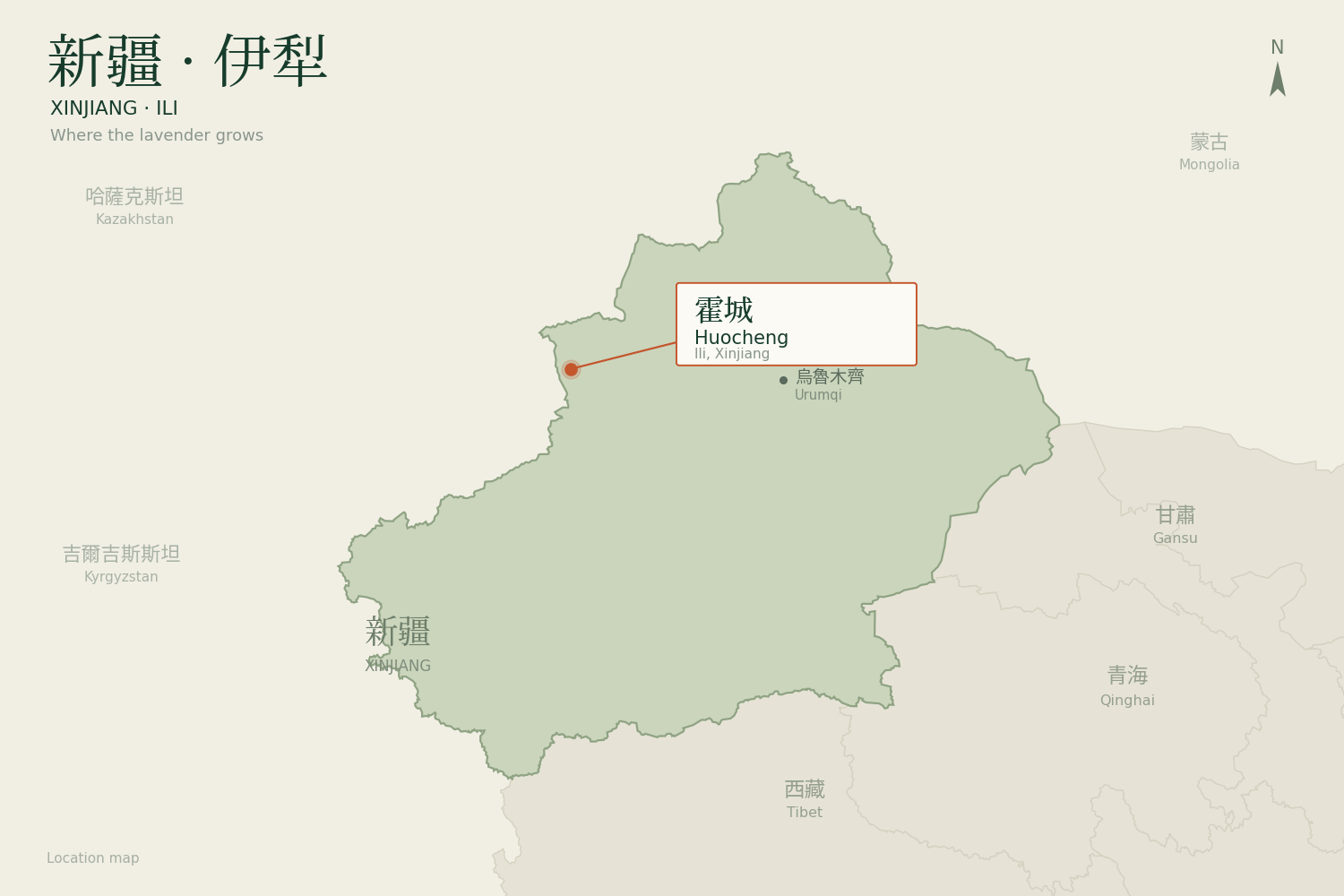
Huocheng sits at the western end of the valley, close to the Kazakh border.
Region
Xinjiang
Prefecture
Ili
Coordinates
42.23–44.83° N, 80.15–84.93° E
Elevation
540–900 m
Mean temp.
10.4 °C
Rainfall
418 mm
Sunshine
2,870 hours
Soil
Sandy loam
Soil pH
7.0–7.9
The valley
Ili is a wedge of land with mountains on three sides and one side open to the west. That opening is the whole geography of the place. Xinjiang is otherwise ringed by ranges that strip the moisture out of anything trying to reach it, which is why most of the region is desert; the Ili valley is the one gap, and weather comes through it.
The result is 418 millimetres of rain a year — modest anywhere else, and the wettest air in Xinjiang by a wide margin. Combine that with 2,870 hours of sun and you have a place that is bright and dry through the day but not parched, which is close to what lavender is from.
The latitude
The planting sits between 42 and 45 degrees north. Provence is at 44, Hokkaido at 43. This is not a coincidence that was discovered later — it is why the trial was run here in the first place.
What the latitude gives is a long summer day and a cold winter, which is the combination the plant needs: enough light to build the oil, and enough cold to force a proper dormancy. Lavender grown somewhere mild flowers more and smells less.
The ground
Sandy loam at pH 7 to 7.9, organic matter at 1.5 percent and above, planted between 540 and 900 metres. Alkaline and free-draining — lavender will not tolerate wet feet, and a heavy soil that holds water through the winter kills the plant outright rather than just reducing the crop.
Planting goes in during October, at roughly 1,200 to 1,600 plants per mu, propagated from cuttings rather than seed so that the cultivar stays what it says it is.
This page describes a plant and its place in Chinese herbal tradition. It is not a description of what our products do, and nothing here is medical advice.